

Sciatica: Causes, Symptoms, Diagnosis, Treatment, and Relief Measures
What Is Sciatica?
Sciatica refers to pain and other neurological symptoms caused by irritation or compression of one or more nerve roots in the lower back. These nerve roots contribute to the sciatic nerve, which travels from the lower spine through the buttocks and into the leg.
Sciatica is therefore not a disease by itself. It is a clinical syndrome caused by irritation or compression of a lumbar or sacral nerve root.
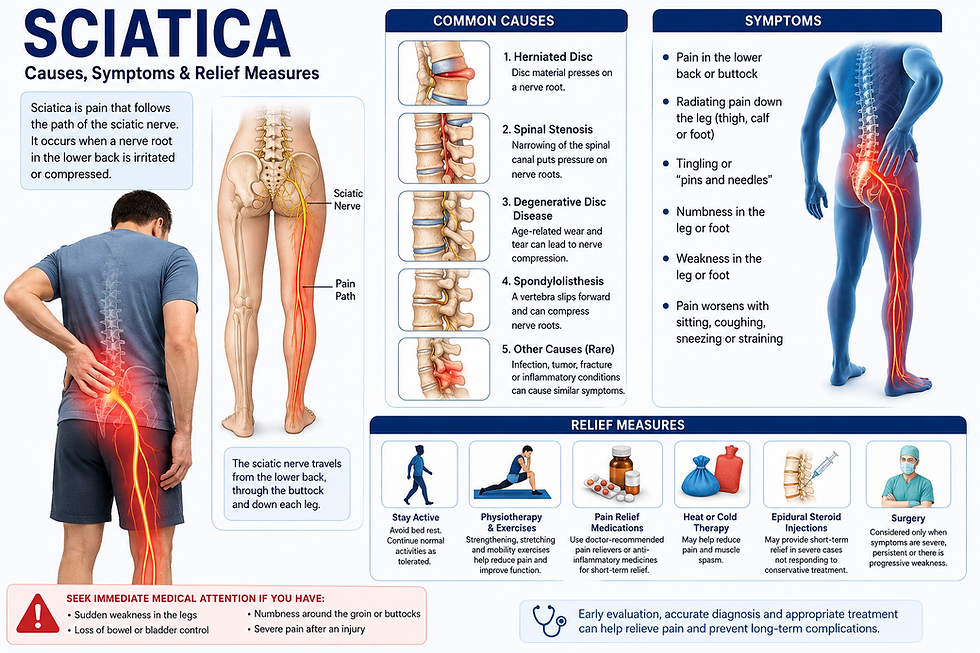
Typical sciatic nerve pain begins in the lower back or buttock and travels down the back or side of the thigh and leg. It usually affects one side, although symptoms can occasionally occur in both legs.
Depending on the severity and the affected nerve root, sciatica may cause pain, tingling, numbness, or weakness in the leg or foot.
Most people with acute sciatica improve with appropriate non-surgical treatment. However, persistent symptoms or significant neurological deficits require medical evaluation.
What Causes Sciatica?
Sciatica occurs when a spinal nerve root becomes compressed, inflamed, or irritated. Several conditions can produce this problem.
1. Herniated Disc
A herniated lumbar disc is one of the most common causes of sciatica.
The discs between the vertebrae act as cushions and allow movement of the spine. If the inner disc material protrudes through a weakened outer portion, it may irritate or compress a nearby nerve root.
This can produce sharp or burning pain that radiates from the lower back or buttock into the leg.
2. Lumbar Spinal Stenosis
Lumbar spinal stenosis occurs when the spaces available for the spinal nerves become narrowed.
It is more common with increasing age and may result from a combination of disc degeneration, facet-joint enlargement, ligament thickening, and other degenerative changes.
People with lumbar spinal stenosis may experience leg pain, numbness, heaviness, or weakness, particularly while standing or walking.
3. Degenerative Disc Disease
As people age, spinal discs can lose some of their height and flexibility. These degenerative changes can contribute to narrowing around the nerve roots.
Disc degeneration does not always cause symptoms, but in some individuals it can contribute to nerve irritation and lower back or leg pain.
4. Spondylolisthesis
Spondylolisthesis occurs when one vertebra shifts relative to another. Depending on the degree and location of the displacement, this can narrow the nerve-root openings and produce symptoms of sciatica.
5. Less Common Causes
Less frequently, symptoms resembling sciatica can occur because of spinal infection, fracture, inflammatory disease, tumors, or other neurological or musculoskeletal conditions.
These causes are uncommon but important because they may require specific and urgent treatment.
What Are the Symptoms of Sciatica?
The most characteristic feature of sciatica is radiating leg pain associated with a lumbar nerve-root problem.
Common sciatica symptoms include:
Sharp, shooting, or burning pain
Electric-shock-like pain
Pain extending from the lower back or buttock into the leg
Tingling or pins-and-needles sensations
Numbness in part of the leg or foot
Weakness of the leg or foot
Difficulty walking in more severe cases
Pain aggravated by prolonged sitting or certain movements
Increased discomfort with coughing, sneezing, or straining in some patients
The exact location of pain and numbness depends on which nerve root is affected.
For example, involvement of different lumbar nerve roots can produce weakness or altered sensation in different parts of the thigh, leg, or foot. A neurological examination can help determine whether symptoms are consistent with a particular nerve-root pattern.
What Does Sciatica Pain Feel Like?
Sciatic pain is often described differently from ordinary muscular back pain.
Patients may describe it as:
Burning
Shooting
Stabbing
Tingling
Electrical
Deep aching
A sensation of pain “travelling” down the leg
Some people have predominantly leg pain with little back pain. Others experience both lower back and leg symptoms.
Importantly, not every pain extending into the leg is sciatica. Conditions involving the hip, sacroiliac region, peripheral nerves, muscles, or blood vessels can sometimes produce similar symptoms.
A proper clinical assessment is therefore important when the diagnosis is uncertain.
Sciatica Diagnosis: How Is It Diagnosed?
Sciatica is primarily diagnosed through a detailed medical history and neurological examination.
A doctor may assess:
Muscle strength
Reflexes
Sensation
Walking pattern
Straight-leg-raise and other nerve-tension signs
Distribution of pain and sensory symptoms
Presence of neurological weakness
The examination helps determine whether symptoms are compatible with lumbar radiculopathy and whether there are signs suggesting a more serious neurological problem.
Do You Need an MRI for Sciatica?
Not everyone with sciatica requires an MRI.
In uncomplicated acute sciatica without warning signs, routine imaging is generally not necessary during the initial assessment. MRI may be appropriate when symptoms are persistent or severe, when there is significant or progressive neurological deficit, when another serious condition is suspected, or when an invasive treatment such as surgery is being considered.
It is also important to understand that abnormal findings on an MRI are common in people who have no pain. Therefore, MRI findings should always be interpreted in conjunction with the patient's symptoms and neurological examination.
How Is Sciatica Treated?
Treatment depends on the cause, severity, duration of symptoms, neurological findings, and the individual's overall health.
1. Stay Physically Active
Prolonged bed rest is generally not recommended for uncomplicated sciatica.
Although severe pain may temporarily limit activity, maintaining reasonable movement and gradually returning to normal daily activities can help prevent deconditioning.
Activities should be modified according to symptoms, particularly during the acute phase.
2. Physiotherapy and Exercise
A structured exercise program can improve mobility, strength, and physical function.
Depending on the individual, physiotherapy may include:
Gentle spinal mobility exercises
Core strengthening
Hip and lower-limb strengthening
Flexibility exercises
Walking or other aerobic activity
Gradual return to normal physical activity
Education regarding movement and activity modification
There is no single exercise that is appropriate for every patient with sciatica. Exercise should be individualized, particularly when significant neurological weakness is present.
3. Pain-Relieving Medication
Appropriate analgesic or anti-inflammatory medication may be used for short-term symptom management in selected patients.
However, medication should be chosen according to the individual's age, medical conditions, kidney and gastrointestinal health, cardiovascular risk, other medications, and potential adverse effects.
Not all medications commonly prescribed for nerve pain have demonstrated meaningful benefit for uncomplicated sciatica. A clinician should therefore guide medication selection rather than relying on self-medication.
4. Heat or Cold Therapy
Some patients experience temporary relief from applying heat or cold to the painful area.
These approaches may help manage symptoms but should be viewed as supportive measures rather than treatments for the underlying nerve compression.
5. Epidural Steroid Injections
In selected patients with severe acute radicular pain, an epidural corticosteroid injection may provide short-term symptom relief.
These injections are not suitable for every patient and do not correct the underlying structural cause of nerve compression. Their potential benefits and risks should be discussed with an appropriately trained clinician.
6. Surgery for Sciatica
Most patients do not require surgery.
Surgical decompression may be considered in carefully selected patients who have persistent, disabling symptoms despite appropriate conservative treatment, particularly when imaging demonstrates nerve compression that corresponds with the clinical findings.
Surgery may also be considered urgently when there is severe or progressive neurological deficit or a clinical picture suggesting cauda equina syndrome.
The decision should be individualized after reviewing the patient's symptoms, neurological examination, imaging, duration of symptoms, and treatment response.
Sciatica Exercises: What Can Help?
Exercise is an important part of recovery for many people with sciatica.
Depending on the cause and stage of the condition, a physiotherapist may recommend:
Walking
Gentle lumbar mobility exercises
Trunk stabilization exercises
Core strengthening
Hip strengthening
Hamstring and lower-limb flexibility exercises
Progressive aerobic conditioning
Exercises should not be chosen solely on the basis of an online list. A movement that helps one patient may aggravate symptoms in another.
If an exercise causes substantial worsening of radiating pain, new numbness, or weakness, it should be stopped and medical advice sought.
How Long Does Sciatica Last?
The duration of sciatica varies considerably.
Many episodes of acute sciatica improve substantially over several weeks, particularly when there is no progressive neurological deficit. Some patients, however, develop persistent or recurrent symptoms.
The underlying cause matters. For example, symptoms associated with a small disc herniation may resolve as inflammation decreases and the nerve recovers, while degenerative spinal stenosis may produce a more chronic pattern.
Persistent symptoms do not necessarily indicate permanent nerve damage, but ongoing pain, numbness, or weakness should be reassessed.
When Is Sciatica an Emergency?
Although most cases are not emergencies, certain symptoms require urgent medical assessment.
Seek immediate medical attention if sciatica is associated with:
New difficulty passing urine or controlling bowel movements
Numbness around the genitals, anus, or inner thighs
Rapidly worsening weakness in one or both legs
Significant weakness affecting walking
Severe symptoms involving both legs, particularly with neurological deficits
Severe back pain after major trauma
Fever or systemic illness with severe back pain
Unexplained weight loss or a history of cancer with new concerning back pain
A combination of severe nerve compression, bladder or bowel dysfunction, and saddle-area numbness may indicate cauda equina syndrome, which is a medical emergency.
Can Sciatica Be Prevented?
Not all episodes of sciatica can be prevented. Age-related spinal changes and disc problems may occur despite good physical health.
Nevertheless, several measures may support spinal health and reduce the risk of disabling back problems:
Exercise regularly
Maintain a healthy body weight
Strengthen the trunk and lower-limb muscles
Avoid prolonged inactivity
Increase physical workloads gradually
Use sensible lifting techniques
Avoid smoking
Maintain good general fitness
There is no single perfect sitting or standing posture that guarantees prevention of back pain. Regular movement and physical conditioning are generally more important than maintaining a rigid posture throughout the day.
When Should You See a Neurologist for Sciatica?
A neurological consultation may be particularly useful when symptoms are severe, persistent, recurrent, diagnostically uncertain, or associated with neurological deficits.
You should consider medical assessment if you have:
Persistent radiating leg pain
Numbness or tingling that does not improve
Leg or foot weakness
Difficulty walking
Recurrent episodes of sciatica
Symptoms that significantly interfere with work or daily activities
Symptoms that are not improving with appropriate conservative treatment
Uncertainty about whether your symptoms are actually caused by sciatica
A neurologist can assess whether the symptoms are due to lumbar radiculopathy or another neurological or musculoskeletal condition and determine whether further testing is appropriate.
Sciatica: Key Takeaways
Sciatica is a symptom caused by irritation or compression of a nerve root in the lower spine. A herniated disc, spinal stenosis, degenerative spinal disease, and spondylolisthesis are among the common causes.
The typical symptoms include radiating leg pain, tingling, numbness, and sometimes weakness.
Most people can initially be managed without surgery through appropriate activity, exercise, physiotherapy, and individualized pain management. MRI is not routinely required for uncomplicated acute sciatica but may be appropriate in selected patients.
Most importantly, progressive weakness, bladder or bowel dysfunction, saddle numbness, or other red-flag symptoms require urgent medical assessment.
If sciatica persists or is accompanied by neurological symptoms, a detailed clinical evaluation can help identify the underlying cause and guide appropriate treatment.
Frequently Asked Questions About Sciatica
1. What is the fastest way to relieve sciatica?
There is no single fastest treatment for everyone. Maintaining appropriate activity, avoiding prolonged bed rest, using individualized pain-relief measures, and beginning an appropriate exercise or physiotherapy program can help many patients. Severe or persistent symptoms should be medically evaluated.
2. Can sciatica go away on its own?
Yes. Many episodes of acute sciatica improve spontaneously over several weeks. The recovery period depends on the underlying cause and severity. Persistent or worsening neurological symptoms require reassessment.
3. Is walking good for sciatica?
Walking is generally a useful low-impact activity for many people with uncomplicated sciatica. It should be introduced at a level that does not substantially aggravate symptoms and gradually increased as tolerated.
4. Should I take complete bed rest for sciatica?
Usually, no. Prolonged bed rest is generally discouraged because it can contribute to physical deconditioning. Short periods of rest may be reasonable during severe pain, followed by gradual return to activity.
5. Is sciatica caused by a slipped disc?
A herniated or “slipped” disc is one of the common causes of sciatica, but it is not the only cause. Spinal stenosis, degenerative changes, spondylolisthesis, and less common conditions can also cause nerve-root symptoms.
6. When does sciatica require surgery?
Most people do not need surgery. Surgery may be considered when disabling symptoms persist despite appropriate conservative treatment or when there is significant/progressive neurological deficit and corresponding nerve compression. Certain emergency neurological presentations require urgent surgical assessment.
7. Does an MRI confirm sciatica?
An MRI can identify structural abnormalities such as disc herniation or spinal stenosis, but an abnormal MRI alone does not prove that it is causing symptoms. The imaging findings must correspond with the patient's clinical presentation and examination.
8. Can sciatica cause permanent nerve damage?
Severe or prolonged nerve compression can potentially result in lasting neurological deficits, but this is not the usual course of uncomplicated sciatica. Progressive weakness, significant numbness, or bladder/bowel symptoms should be assessed urgently.
9. Can stress cause sciatica?
Stress does not usually directly compress a spinal nerve. However, stress, poor sleep, and psychological distress can influence pain perception, coping, muscle tension, and recovery from back pain.
10. Which doctor should I see for sciatica?
A primary-care physician, neurologist, spine specialist, orthopaedic specialist, or appropriately trained physiotherapist may be involved depending on the presentation. A neurologist is particularly relevant when there is numbness, weakness, diagnostic uncertainty, or other neurological symptoms.
Medical disclaimer:This article is intended for general educational purposes and does not replace an individual medical consultation. Treatment should be tailored to the patient's symptoms, examination findings, medical history, and, when appropriate, imaging or other investigations.


Comments